

The Modern Parlor
Why We Keep Rebuilding the Same Room in Every Era
I had a fantastic chat with @chriscocreated and @arjantupan today. We're beta testing Depthcaster, Chris's new project, which enables community and self-curation of the Farcaster experience. But the conversation we had was broader; it's about connecting with great ideas and the people creating them. A curated feed is only part of that experience. Everyone who has gone to a Farcaster meetup knows the feeling of being surrounded by the people who you love from your community, chat, and channel.
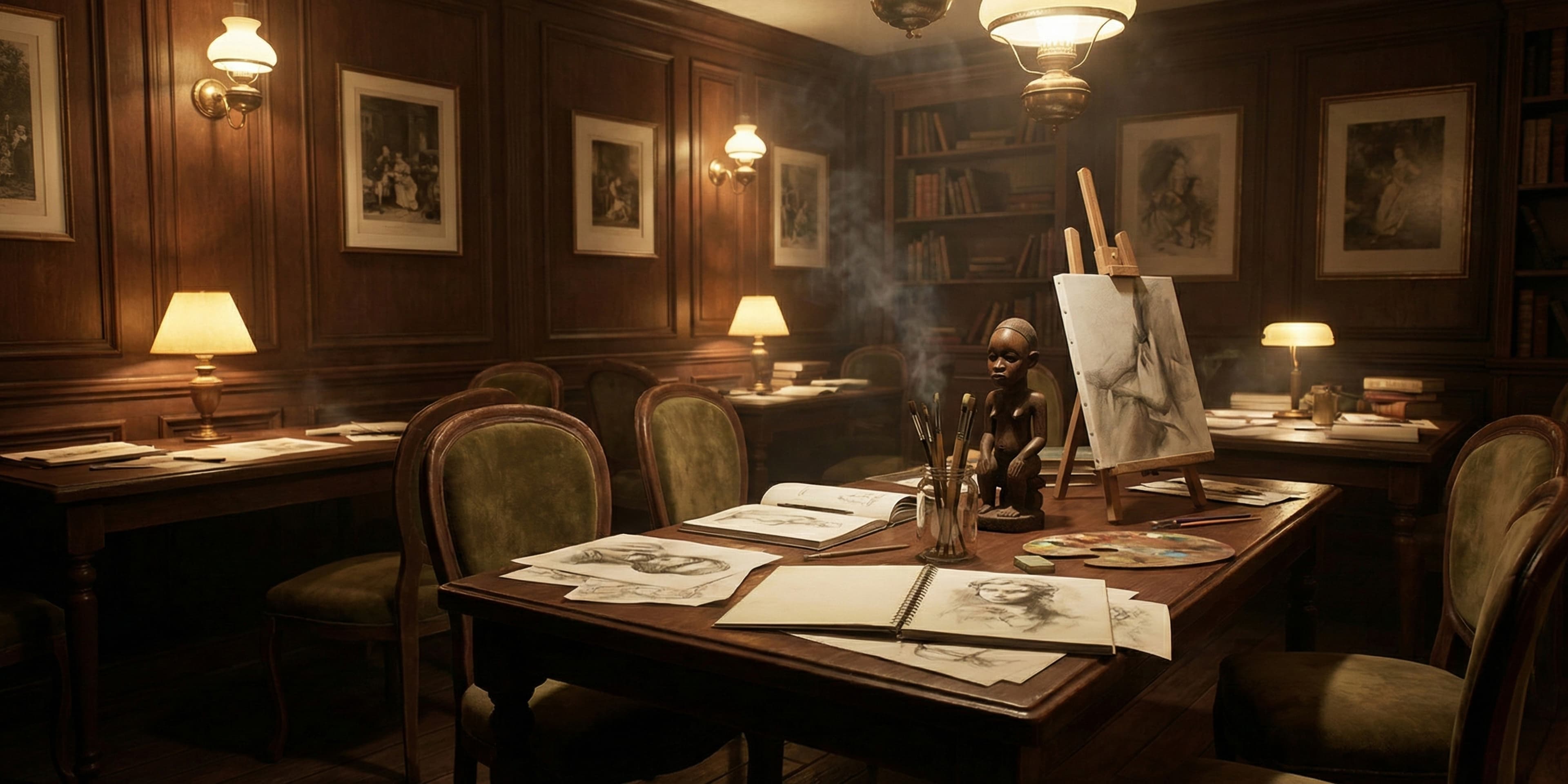
Before digital feeds, before online group chats, people gathered in physical rooms. Parlors and cafés emerged as parallel social engines: parlors anchoring private, invitation-only gatherings inside homes and salons, and cafés serving as the public hubs where ideas, debates, and artistic movements circulated. Different architectures, same underlying purpose. These spaces were where conversations deepened, alliances formed, and creative sparks caught.
Parlor (or Parlour): Historically, a room set aside for receiving visitors and holding conversations. In the 18th and 19th centuries, it served as a primary site for discussion, debate, artistic exchange, and informal community life. Even as public cafés grew into cultural powerhouses, the parlor remained the intimate room where ideas mixed more quietly, and relationships took shape face to face.
We don’t use the word much anymore, but the architecture of the parlor never disappeared. It simply changed form. The room remains because the human jobs remain.
If you want to understand the power of the parlor, look to Paris in the late nineteenth century. The Impressionists didn’t invent a movement in solitude. They built it by gathering night after night in cafés, salons, and small apartments across Montmartre and the Grands Boulevards. Monet, Renoir, Degas, Morisot, Pissarro, and Cézanne argued, critiqued, challenged, and refined one another’s thinking. Their art changed the world, but the ideas were shaped in rooms filled with smoke, laughter, disagreement, and ambition. The parlor made the movement possible.
And sometimes the parlor bottles lightning.
Henri Matisse once brought an African sculpture to dinner and showed it to Picasso. Picasso had been circling something new without finding it. Matisse had just discovered a radically different artistic vocabulary. The sculpture itself carried an entirely separate lineage of form and abstraction. Each element alone was inert. But together, in the same room, at the same moment, they created a spark. Picasso stayed up all night studying the piece, sketching, and beginning the shift that would lead to Les Demoiselles d’Avignon — the breakthrough that launched modern art.
That is the essence of the parlor. It creates the conditions for collisions that do not happen alone. The room is only the container. The electricity comes from the mix: people, ideas, objects, timing, and appetite for something new.
You see this same structure in places like the Anglers’ Club of New York City, more than 120 years old. You don’t simply sign up. You are proposed, seconded, and absorbed into a fabric of shared rituals, trips, stories, and reputations. People gather to fish, to eat, to drink, to argue, and to tell stories. But beneath the surface, the same ancient jobs remain: connection, belonging, meaning, status — and occasionally, a spark that reshapes someone’s thinking.
Digital communities recreate this logic today at scale. The walls are gone, but the parlor remains — only now it’s a channel, a Space or Farhouse, or a group chat. These spaces function exactly like the parlors of the past. They gather the right people, at the right moment, around the right sparks. Ideas move faster, the collisions come sooner, and the mix is global instead of local.
Strip away the surface differences, and the same structure appears every time.
A parlor coordinates the flow of ideas.
People come to trade information, meet collaborators, challenge assumptions, and pressure-test their thinking. For the Impressionists, it was where they rewrote the rules of color and light. For the Anglers’ Club, it is where techniques and opportunities circulate. For digital builders, it is where prototypes, feedback, and user insights move in real time.
A parlor creates community.
Shared interests alone don’t produce belonging. Repetition, norms, and presence do. The Impressionists formed a counterculture in opposition to the Académie. Clubs like the Anglers’ do this through ritual and familiarity. Digital communities mirror it through language, norms, and constant interaction.
A parlor provides emotional anchoring.
The Impressionists faced years of rejection. The parlor was the only room where their work was understood. That emotional reinforcement kept them moving forward. Membership clubs offer the same. Digital parlors do this for far more people than could ever fit in a room.
And a parlor is always a stage for status.
Eugene Wei calls humans “status-seeking animals.” The parlor is where this plays out. The Impressionists negotiated internal hierarchies and external legitimacy in their cafés. Clubs encode status through tradition and tenure. Digital communities encode it algorithmically through reach, influence, and contribution. The job is constant: people want to understand who they are inside the group that matters.
This is why the parlor keeps resurfacing. It solves fundamental human needs. It helps us coordinate identity, belonging, influence, and meaning. It is the room where movements form, friendships take shape, and ideas collide hard enough to produce something new.
The formats change. The blueprint endures.
We are still looking for the parlor, still walking into new rooms that serve the same purpose.
And increasingly, those rooms are digital.
A great exchange with @chriscocreated and @arjantupan today made something click for me: the parlor never disappeared. It just changed form. Wrote about it here: https://paragraph.com/@jonathancolton.eth/the-modern-parlor