This Week in All Things AI - Week 33-2026
Sunday 9th August 2026 to Saturday 15th August 2026
This Week in All Things AI covers key developments in models, agents, tools, infrastructure, and policy curated from discussions in the All Things AI Telegram group.
If you follow AI for work, research, investing, or just to understand where the technology is heading, this weekly brief is a concise way to scan the most important launches, risks, and resources in a few focused minutes.
The week of 9th to 15th August 2026 brought a dense run of releases across agentic models, autonomous-workflow tooling, and AI infrastructure finance. Meta introduced Muse Glimmer, a 30B open-weight model for always-on local agents, while NVIDIA launched Nemotron 3.5 Lightning and NeMo Switchyard, pairing a fast open agent model with workflow-level model routing. DeepSeek made V4-Pro generally available and released its modular, MIT-licensed Harness developer preview; Google shipped Gemini 3.7 Flash, and Z.ai announced GLM-5.3 for coding, agents, and cyber-defense work.
The week also underscored the shift from chatbots to durable AI operators: SpaceXAI introduced Grok Bot, persistent agents that work inside connected apps, while SignerSet proposed policy-based, multi-party approvals for consequential autonomous actions. On the infrastructure side, NVIDIA outlined financing partnerships intended to mobilize more than $500 billion for data centers, power, and GPU capacity, and Anthropic reportedly struck a long-term compute agreement with Riot Platforms. Other notable threads included Anthropic’s planned invisible text watermarking, OpenAI finance-team workflow examples and the economic trade-off between AI “tax” and AI “dividend.”
The sections that follow walk through these items day by day, with short context and links so you can dive deeper into the pieces most relevant to your work or interest
Sunday 9th August 2026
Monday 10th August 2026
via Charles Stanton
This is very cool, Harvard and MIT scientists have replicated the human population by creating 8.3billion agent personas, effectively allowing them to trial global initiatives virtually.
MatrAIx: a population-scale AI simulation infrastructure designed to model the behavior of virtually every person on Earth.


Harvard and MIT Researchers Simulate the Entire Planet with 8.3 Billion AI Personas
It is big.
In a development that feels straight out of science fiction, a large collaborative team led by researchers from Harvard University and the Massachusetts Institute of Technology has
It is big.
In a development that feels straight out of science fiction, a large collaborative team led by researchers from Harvard University and the Massachusetts Institute of Technology has
 1,146
1,146
Meta Releases Muse Glimmer, 30B Open-Weight Model for Local AI Agents
Meta launched Muse Glimmer, a 30B-parameter open-weight model under Apache 2.0 license, designed for always-on local agents on consumer hardware with 24GB VRAM. It excels in vision, tool use, multi-step reasoning, and benchmarks like MCP Atlas where it scored 75.5, beating rivals such as Gemma 4-31B.

1/ big announcement today: we will be releasing an open weight version of muse spark 1.2 soon.
we also are releasing muse glimmer, a 30B agentic model with open weights under apache 2.0. muse glimmer can run on 24GB of VRAM without losing agentic reliability.
we also are releasing muse glimmer, a 30B agentic model with open weights under apache 2.0. muse glimmer can run on 24GB of VRAM without losing agentic reliability.

Introducing Muse Glimmer, an open-weight 30B-parameter model optimized for local, always-on agent workflows.
Muse Glimmer delivers strong performance on key agentic use cases and benchmarks compared with leading models in its size category, and is designed to run entirely on
Muse Glimmer delivers strong performance on key agentic use cases and benchmarks compared with leading models in its size category, and is designed to run entirely on
Tuesday 11th August 2026
NVIDIA Partners with Wall Street Giants to Unlock $500 Billion for AI Infrastructure
NVIDIA signed deals with Apollo, BlackRock, Blackstone, Brookfield, Goldman Sachs and KKR to mobilize over $500 billion in capital for data centers, power and GPUs. These independent financing platforms let customers secure funding at attractive rates, turning NVIDIA's AI compute into a new investable asset backed by its CUDA ecosystem.
Independent financing platforms let capital providers underwrite demand, utilization, cash flow and residual value, with limited NVIDIA residual-value support up to 25%.
Huang explained that in AI, compute equals revenue, and this brings long-term institutional money into the market amid surging infrastructure spending that's boosting U.S. GDP like never before.


$NVDA
Okay, so let’s talk about what Nvidia actually announced today…
I’ll present the bear and the bull case. I lean more bullish for reasons that are below, but I want to highlight both sides and what this means for the broader AI industry.
So, what did Jensen do today that
Okay, so let’s talk about what Nvidia actually announced today…
I’ll present the bear and the bull case. I lean more bullish for reasons that are below, but I want to highlight both sides and what this means for the broader AI industry.
So, what did Jensen do today that
Compute Is Revenue. Revenue Is Collateral.
Nvidia did not invent compute-backed credit on Monday. It proposed an assembly line for it.

Anthropic says new Claude models will embed invisible watermarks in all generated text, everywhere Claude is offered.
The watermark is part of the text, it isn't metadata: "it will travel with the text when it's copied and pasted elsewhere, and may persist through some editing."
This starts with models launched on or after August 2, 2026, under an EU AI Act code Anthropic signed. Anthropic is still working on adding it to current models. The rollout is worldwide.
How Claude marks AI-generated content | Claude Help Center
Anthropic has signed the EU AI Act's Article 50(2) Code of Practice on Transparency of AI-Generated Content, as a provider of both generative AI models and generative AI systems. This article describes how we're planning to put those commitments into practice, how marking works, and what its limitations are.

via David James
Seeking an academic co-author — AI, cultural memory, and migration
I'm developing a research proposal for Coefficient Giving's RFP on Global Health and Wellbeing in an Era of Transformative AI (Exploratory grant), and I'm looking for an academic partner to lead the method.
The hypothesis: Africa's oral knowledge systems — botanical, climatic, agronomic, linguistic, held by griots and traditional knowledge-keepers — are on the wrong side of the AI era by default. Frontier models are trained on written, Western corpora; unwritten knowledge is invisible to them, and so is devalued by them. Yet the same AI advances mean these knowledge systems will soon hold enormous discoverable value. The question is who will own it when that moment arrives — the communities, or whoever digitises them first.
The proposed work: a research paper on AI-era knowledge homogenisation, cultural detachment and migration aspirations; a community-ownership and benefit-sharing governance framework for oral-knowledge corpora (Nagoya/CARE-aligned); and a costed pilot corpus design with one community.
I'm looking for a co-author in low-resource NLP / computational linguistics, anthropology or ethnobotany, or migration economics — someone who would lead the research method, with me contributing the practitioner frame and thirty years of field relationships across African and Asian agricultural communities. My own work on language, consciousness and AI (Your Mind at Siege, on the Diamond Sutra and AI) shapes the framing.
Deadline is near — 21 August — so this suits someone who can move quickly on a light, sharply-scoped proposal. If this is your field, or you know whose field it is, my messages are open.
Anthropic agreed to a 20-year, $9.1B compute deal with Riot Platforms a Bitcoin mining company that also recently began selling AI data center capacity for 191 MW of capacity at a Rockdale, TX campus; RIOT jumps ~25% after hours

Anthropic has struck a $9.1 billion deal with Riot, a Bitcoin mining company that also recently began selling AI data center capacity, according to sources, underscoring the Claude maker's efforts to secure enough computing to meet demand
bloomberg.com
Anthropic Strikes $9 Billion Deal With Cloud Computing Firm Riot
Anthropic PBC has struck a $9.1 billion deal with Riot Platforms Inc., a Bitcoin mining company that recently began selling AI data center capacity, people familiar with the matter said, underscoring...
Harry Stebbings profiles OpenRouter as a breakout AI inference company co-founded by ex-OpenSea leader Alex Atallah, noting its hundreds of millions in revenue, profitability, 25 trillion weekly tokens processed (corrected to 70-75 trillion in replies), and a reported $10BN Stripe acquisition offer after a recent $1.3BN valuation.
The post summarizes seven interview insights, stressing AI model inference as tech's largest future market via Jevons Paradox-driven usage growth, the superiority of focused routing over side-feature competitors, and risks of frontier labs absorbing startup workflows
Key themes include accelerating model releases every 10 hours creating a multi-model ecosystem, China's edge in open-weight AI, open models closing performance gaps on frontier ones, and businesses needing to treat AI inference spend as variable employee costs.

OpenRouter is one of the most insane stories in tech.
Co-founded by OpenSea founder, Alex Atallah. It has become one of the most important companies in AI.
Scaled to 100s of millions in revenue and wildly profitable.
They process 25 TRILLION tokens every week and will do 1
Co-founded by OpenSea founder, Alex Atallah. It has become one of the most important companies in AI.
Scaled to 100s of millions in revenue and wildly profitable.
They process 25 TRILLION tokens every week and will do 1
via Jorvik Zhang
The eight debates from the AI First seminar in London last Thursday, in one short deck: https://tokenhub.tencentcloud-eu.com/AI-First.html
Still the sharpest of them — AI tax vs. AI dividend.
The tax is what you pay correcting and re-prompting. The dividend is what you keep when it lands the first time. Most teams feel the tax daily but can't yet name the dividend.
Which is bigger for your team
NVIDIA Unveils Nemotron 3.5 Lightning for Fast AI Agents
This open-source model uses a hybrid Mamba-Transformer design and a permissive license for commercial use, boasting a 1 million token context window and up to 4x the output speed of similar models. Benchmarks show it scoring 24 on the Artificial Analysis Intelligence Index, matching much larger rivals, with standout results in agent tasks like GDPval-AA v2 at 824 Elo and 86% on PinchBench—while finishing 10,000 tasks 35% faster than competitors.

Introducing NVIDIA Nemotron 3.5 Lightning
An open 30B MoE model with 3B active parameters, built for always-on agents to complete high-volume, specialized tasks faster.
It delivers up to 4x the output speed of similar-sized models.
An open 30B MoE model with 3B active parameters, built for always-on agents to complete high-volume, specialized tasks faster.
It delivers up to 4x the output speed of similar-sized models.

NVIDIA has just released the first Nemotron 3.5 model: Nemotron 3.5 Lightning, a highly efficient small open weights model with performance similar to gpt-oss-120b at around a quarter of the total parameters
Nemotron 3.5 Lightning is the successor to @nvidia Nemotron 3 Nano 30B
Nemotron 3.5 Lightning is the successor to @nvidia Nemotron 3 Nano 30B

NVIDIA Nemotron 3.5 Lightning is now live on Together AI.
The fastest open model in its class is built for always-on agents that need to complete high-volume, specialized work quickly.
The fastest open model in its class is built for always-on agents that need to complete high-volume, specialized work quickly.
Nvidia also released NeMo Switchyard: an open-source model routing library that automatically directs each step of an agent workflow to the best model for the job. Internal benchmarks: frontier-level accuracy at ~1/3 the cost of Opus 4.8 alone.
Devin cut mean cost 28%. LangChain cut cost 74% by routing just 7% of calls to a frontier model. The savings are in the routing, not the model.

Today, NVIDIA announced NVIDIA Nemotron 3.5 Lightning, a customizable model for high-volume, specialized work, and NVIDIA NeMo Switchyard, which helps agents route each workflow step across the models they choose. x.com/i/article/2086…
x.com/i/article/2086…
NVIDIA Nemotron 3.5 Lightning and NeMo Switchyard Deliver Faster, Smarter, More Efficient Agentic AI
The new lightweight open model and routing library delivers greater control over AI, data and workflows across edge devices, PCs, workstations, data centers and the cloud.

Wednesday 12th August 2026
via Alfred Tom
Is anyone running autonomous agent workflows, like OpenClaw, Cursor, Hermes, Animoca Minds, etc.? We're launching something that brings the concept of banking-style approvals to autonomous workflows. Basically it helps prevent things like deleting production databases without requiring a human in the loop (although it supports that as well). If you're interested I'm happy to help with integrations
SignerSet - Approvals for Autonomous Workflows
Policy-based, multi-party approval for consequential AI actions. Define protected actions, authorized signers, and signature thresholds.

SpaceXAI Launches Grok Bot AI Teammates for Real Work
Grok Bot introduces persistent AI agents that sign into tools like Gmail, Salesforce, and LinkedIn to complete end-to-end tasks, learn from demonstrations, and collaborate with each other in chats. Each bot runs on its own cloud computer, remembers preferences, and improves over time, already transforming internal operations in sales, marketing, and engineering at SpaceXAI. Early users like Lenny Rachitsky praise its practical power for job matching, auto-replies, and expense scanning, while Elon Musk plans a wider beta after quick fixes and Grok 4.6. Access begins for SuperGrok Heavy and Cursor subscribers on desktop and iOS.
Introducing Grok Bot
Grok Bot is your team of always-on agents. They have their own computer, work inside tools and apps like you do, and keep working 24/7.


Introducing Grok Bot, now in early beta.
Bots are AI teammates that do real work for you. They sign in to your tools, use them just like you do, and come back with finished work.

Bots are AI teammates that do real work for you. They sign in to your tools, use them just like you do, and come back with finished work.

We will widen the Grok Bot beta after we fix basic issues with the early beta and release Grok 4.6 later this week

GrokBot Just Launched:
GrokBot is Cursor/SpaceX new general agent platform for Desktop and iOS...
Got access yesterday... here are the things that Grokbot can do, my thoughts, and what I hope they add soon.
Pretty big news for those who want to build businesses that are

GrokBot is Cursor/SpaceX new general agent platform for Desktop and iOS...
Got access yesterday... here are the things that Grokbot can do, my thoughts, and what I hope they add soon.
Pretty big news for those who want to build businesses that are

I got early access to Grok Bot and I'm hooked.
I haven't been this excited about a new AI product in a while.
It's like OpenClaw, but super easy, reliable, and less scary to use. I think this will be a huge new product line for Cursor/Grok/SpaceX.
I've already found so many
I haven't been this excited about a new AI product in a while.
It's like OpenClaw, but super easy, reliable, and less scary to use. I think this will be a huge new product line for Cursor/Grok/SpaceX.
I've already found so many
Built a tool that scores any website on a 6-level Agent Readiness framework — from basic HTTPS (L0) to autonomous AI payments via x402 protocol (L4). Most sites are stuck at L1.
seo4agent.com — free instant audit
github.com/varustamov/agentable-core — MCP server + Python SDK (pip install agentable-core)
Will be glad to get your reviews, feedback & stars on GitHub
Mark Zuckerberg proposes a positive AI philosophy centered on individual empowerment, predicts personal superintelligence could increase employment, and more
Thursday 13th August 2026
DeepSeek V4 Pro GA and Grok 4.6 Launch on Same Day
DeepSeek's V4 Pro, now generally available on API and chat, offers a 1 million token context window, up to 384K output, JSON support, tool calls, and pricing at $0.003625 per million input tokens on cache hit, $0.435 on miss, and $0.87 for output.
SpaceXAI quickly launched Grok 4.6, optimized for coding, agentic tasks, and knowledge work with adjustable reasoning levels.

Introducing Grok 4.6.
It delivers frontier intelligence and is a significant improvement over Grok 4.5 at the same price.
It delivers frontier intelligence and is a significant improvement over Grok 4.5 at the same price.

DeepSeek v4 Pro GA is rolling out! Grok 4.6 API spotted as well!
Really excited! After the most recent insane update to DeepSeek v4 Flash i expect sevel updates on this one as well!
big release day it seems!
 DeepSeek V4 Pro (GA) is now rolling out on the DeepSeek API and on DeepSeek Chat
Really excited! After the most recent insane update to DeepSeek v4 Flash i expect sevel updates on this one as well!
big release day it seems!
 DeepSeek V4 Pro (GA) is now rolling out on the DeepSeek API and on DeepSeek Chat

DeepSeek V4 Pro GA confirmed to be released as DeepSeek-V4-Pro-0813.


Confirmed release DeepSeek-V4-Pro-0813


grok 4.6 is live! a write up on my learnings, findings and tips to using the model! x.com/i/article/2087…
SpaceXAI's Grok 4.6 scores 61 on the Artificial Analysis Intelligence Index, joining the frontier in line with GPT-5.6 Sol, with standout agentic performance at lower cost
Grok 4.6 gains 5 points over Grok 4.5 on the Intelligence Index just over one month after its release, or
Grok 4.6 gains 5 points over Grok 4.5 on the Intelligence Index just over one month after its release, or
Derrick Choi, OpenAI's Codex APAC Lead, promotes 16 real workflows created by their finance team using ChatGPT Work and Codex for tasks from monthly close and variance reconciliation to forecasting adjustments and treasury analytics.
Key examples include dynamic marketing spend rebalancing, headcount visibility dashboards, intelligent scenario modeling, governed monthly close processes, and AI-powered treasury agents that flag issues and draft responses
The approach automates data assembly, reconciliation, and reporting to shift finance focus toward decisions, tradeoffs, and strategic conversations while retaining human sign-off and accountability.

Our finance team shared 16 workflows with ChatGPT Work and Codex, from monthly close to forecasting and treasury.
Really good read especially if you’re in finance.
Really good read especially if you’re in finance.
openai.com
AI Workflows for Finance Teams
Explore 16 strategic finance workflows built with ChatGPT Work and Codex, from decision support and close to forecasting, planning, and agent orchestration.
Elon Musk Announces Grok 4.7 Launch in 3-4 Weeks
Musk said Grok 4.7, boosted by massive SpaceX company data in supplemental training, will outperform all current models—especially in practical engineering tasks. It follows hot on the heels of Grok 4.6, now available via tools like Cursor and the SpaceXAI API, with strong showings in coding, agents, and benchmarks against GPT variants
Grok 4.7 is significantly better than 4.6 and should be ready in 3 to 4 weeks.
Initial training is complete and now we’re adding a massive amount of SpaceX company data in supplemental training. This will be something special.
Initial training is complete and now we’re adding a massive amount of SpaceX company data in supplemental training. This will be something special.
Grok 4.7 will exceed all current models.
That said, Anthropic is a great company and will probably release improved models soon.
However, the SpaceX training corpus is so awesome & unique that I would be shocked if any model is better at real-world engineering than 4.7.
That said, Anthropic is a great company and will probably release improved models soon.
However, the SpaceX training corpus is so awesome & unique that I would be shocked if any model is better at real-world engineering than 4.7.
DeepSeek launched V4-Pro with major agent upgrades, flexible reasoning modes (low/high/max effort), and native OpenAI Responses API support optimized for Codex workflows.
Benchmarks show V4-Pro-0813 leading in agentic tasks like Terminal Bench (87.9), DeepSWE (62.7), and DSBench-Hard (67.2), outperforming previews and rivals including Kimi-K3 and Opus-4.8.
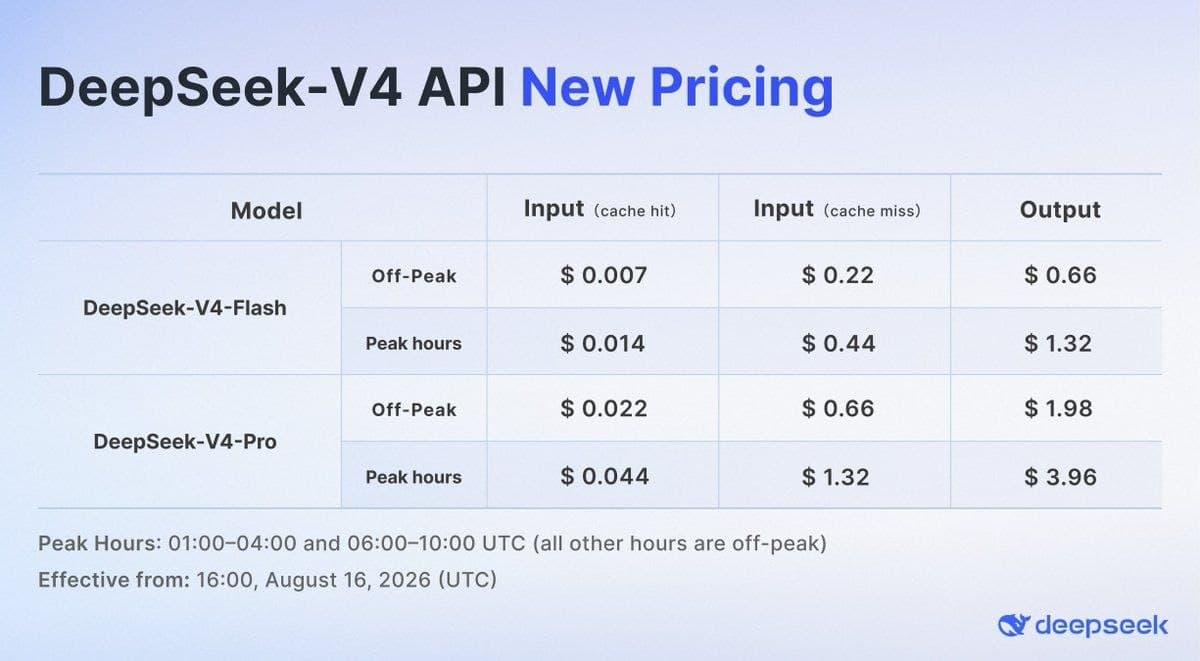
API pricing update introduces peak/off-peak rates with off-peak 50% cheaper, effective August 16, 2026, for both V4-Pro and V4-Flash models.

We’re launching DeepSeek-V4-Pro today! 
 Major Agent upgrades with strong production gains!
Flexible reasoning effort for V4-Pro & V4-Flash: low for simple tasks, high for daily Agent workflows, max for complex tasks.
Native OpenAI Responses API support, optimized for

Major Agent upgrades with strong production gains! Flexible reasoning effort for V4-Pro & V4-Flash: low for simple tasks, high for daily Agent workflows, max for complex tasks. Native OpenAI Responses API support, optimized for
DeepSeek AI announced DeepSeek Harness v0.1 in developer preview as an open-source agent harness under MIT license, inviting global developers to build and extend it.
The framework uses a "everything is a plugin" architecture powered by the Cordis meta-framework, allowing models, tools, sessions, sandboxes, orchestration, and UI to be mixed, matched, replaced, or extended modularly.
It focuses on reliable agent execution by handling engineering aspects like task orchestration, memory management, tool scheduling, and error recovery to bridge models into practical agents
 DeepSeek Harness v0.1 is now available in Developer Preview!
 We’re opening it up to developers building agent harnesses worldwide and open-sourcing the codebase in MIT license. Powered by the Cordis meta-framework, DeepSeek Harness is an agent harness built around one

github.com
GitHub - deepseek-ai/deepseek-harness: DeepSeek Harness: Everything is a Plugin.
DeepSeek Harness: Everything is a Plugin. Contribute to deepseek-ai/deepseek-harness development by creating an account on GitHub.
Friday 14th August 2026
via Robby Yung

Gemini 3.7 Flash announced highlighting its high speed, 50% price reduction versus 3.6 Flash through year-end, and major intelligence gains from algorithmic improvements in roughly three weeks.
Benchmark charts show 3.7 Flash leading in enterprise workflow automation (30.4% on AutomationBench), web development (1588 Elo on Code Arena), long-horizon software engineering (65.3% on DeepSWE), and production code quality (43.6% on FrontierCode), surpassing 3.6 Flash and competitors like Claude Sonnet 5 and GPT-5.6.
The model is now available in the Gemini API, AI Studio, Antigravity, and additional platforms, reflecting Google's rapid iteration on the Flash series for better real-world usability.

Introducing Gemini 3.7 Flash : )
- it is fast!
- 50% lower price than 3.6 flash (through end of year)
- strong intelligence increase in only ~3 weeks (thanks to some awesome algorithmic improvements)
- available in the API, AI Studio, Antigravity, and more!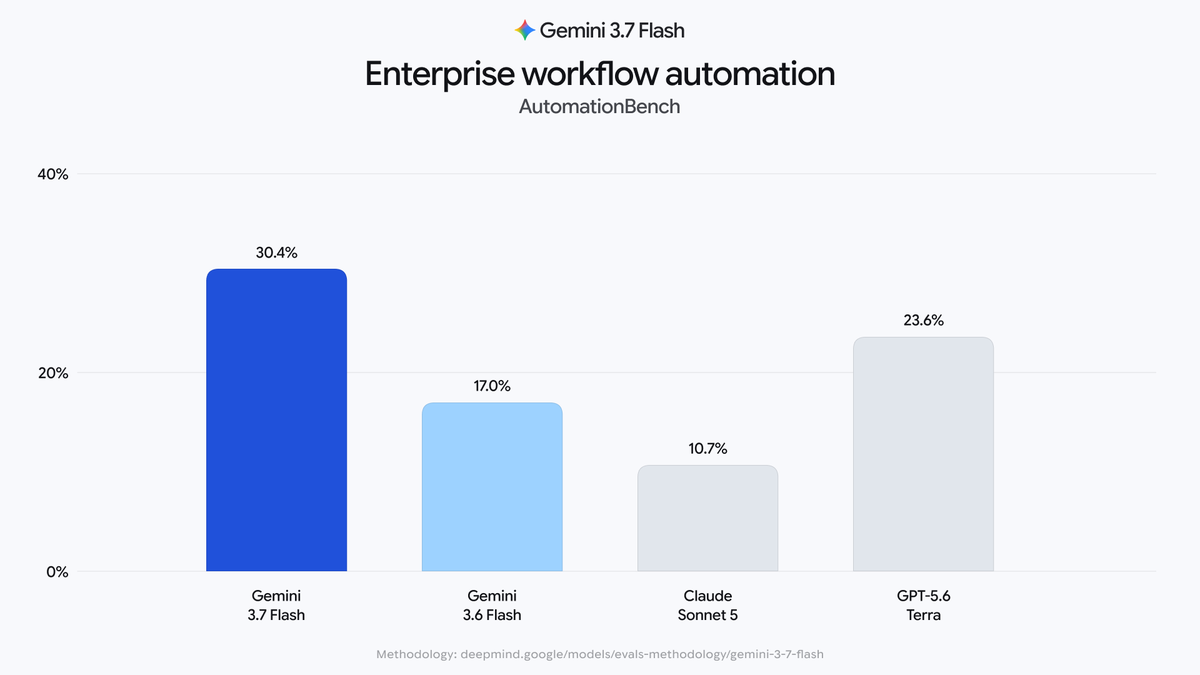
- it is fast!
- 50% lower price than 3.6 flash (through end of year)
- strong intelligence increase in only ~3 weeks (thanks to some awesome algorithmic improvements)
- available in the API, AI Studio, Antigravity, and more!
Introducing Gemini 3.7 Flash
Gemini 3.7 Flash is our most intelligent workhorse model yet for coding and agents.

Z.ai announces GLM-5.3, post-trained on a 743B base model, highlighting top-tier coding, agentic capabilities, and a major advancement in cybersecurity for open models.
Benchmark charts show GLM-5.3 leading in Terminal Bench 3.0, DeepSWE, CyberGym, ExploitBench, and agentic coding accuracy, outperforming GLM-5.2 and competing strongly with models like Kimi K3 and Claude variants.
The model is available now through GLM Coding Plan and ZCode, with staged API access and open weights following safety evaluations, plus initial partner services.

GLM-5.3 is available now through GLM Coding Plan and ZCode. API access and open weights will be released in stages following rigorous safety evaluations.
GLM Coding Plan: z.ai/subscribe
ZCode: zcode.z.ai/en
GLM Coding Plan: z.ai/subscribe
ZCode: zcode.z.ai/en

GLM-5.3 uses the same 743B base model as GLM-5.2, while matching the performance of models several times its size. Benchmark highlights:
- Terminal Bench 3.0: 28.3
- DeepSWE: 66.9
- Agents' Last Exam: 28.5
- GDPVal-AA: 1769
- Terminal Bench 3.0: 28.3
- DeepSWE: 66.9
- Agents' Last Exam: 28.5
- GDPVal-AA: 1769
Introducing GLM-5.3: Built to Code. Ready for Cyber Defense.
- Top-tier coding and agentic capabilities, achieved through post-training on the 743B base model
- A major leap in cybersecurity, setting a new standard among open models
Tech Blog: z.ai/blog/glm-5.3
- Top-tier coding and agentic capabilities, achieved through post-training on the 743B base model
- A major leap in cybersecurity, setting a new standard among open models
Tech Blog: z.ai/blog/glm-5.3

IMHO, signing up for Monid (you get $1 in credits on signup) and installing its MCP server will dramatically change the way you work with your harness [Cursor, ChatGPT, Claude, Grok Build, Opencode, Command Code etc]

Also, Tinyfish is available as a ChatGPT plugin [search and fetch are free] but you can also install it as a MCP server in other harnesses

TinyFish is now officially available in @ChatGPT.
TinyFish brings live web Search, clean Fetch, and Web Agent to ChatGPT, so your agent can find it, read it, and act on it.

TinyFish brings live web Search, clean Fetch, and Web Agent to ChatGPT, so your agent can find it, read it, and act on it.
Saturday 15th August 2026
Below is my personal website which aggregates links to many of my socials as well as the various content and community that I curate. Feel free to share this link to others who you think may find this content/community useful to them
The cover image of this newsletter via generated via the Seedream 5 Pro model within the Krea tool via the following prompt
Retro Futurism style, It is a city designed by Buckminster Fuller on Mars in 2500, influenced by the Purism architectural movement and can change shape according to needs